

Why did the new Syrian government open its first embassy in the United Kingdom instead of Turkey?
According to the Sedaye Sama News Agency, These days, in many Turkish media outlets and political circles, there is ongoing discussion about this question: How will the relations of the new Syrian government with the United States and Europe evolve, and how influential will the Turkish government be in this equation?
This question is important because media and newspapers close to Turkey’s ruling party have always portrayed a picture of the new Syria in which its political and defense officials act entirely based on consultations with Ankara’s authorities.
These media outlets have repeatedly and enthusiastically republished the part of Donald Trump’s remarks in which he claimed: “The key to the new Syria is in Turkey and with Erdoğan.” However, the latest statements of British security officials revealed that since 2023 they have been in contact with Jolani’s team in Idlib, and that the new developments in Syria were not engineered in Ankara.
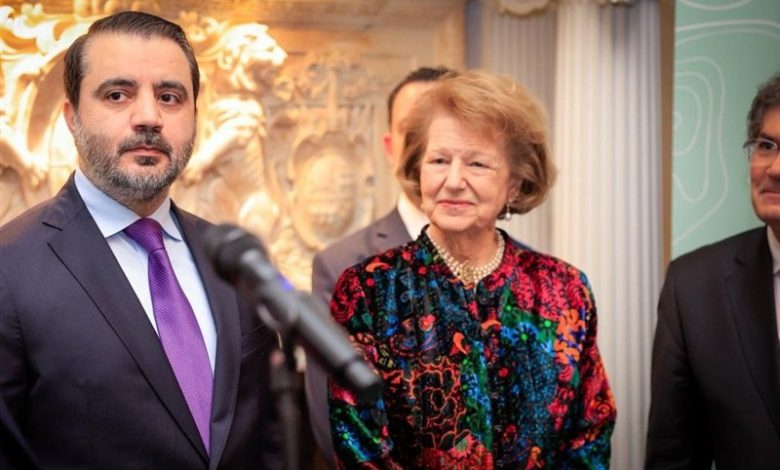
At the very moment these issues are being evaluated in the Turkish media, Assad Hassan Al-Shaybani, the Minister of Foreign Affairs in the interim government of Ahmad Al-Shar’a, traveled to Britain and reopened Syria’s embassy in London.
Why London?
Many analysts expected that, considering the close relationship between Erdoğan and Ahmad Al-Shar’a, the first embassy of the new Syria would be reopened in Turkey, not in Britain. Shaybani said about this:
“We held extensive talks with Turkish officials, and we have approached the historical moment of reopening the embassy in Ankara.”
Shaybani said in his remarks during a session titled “The Foreign Policy of the New Syria” at Chatham House in London:
“Syria is no longer a marginal country. This country is important for all states of the world. The current relations between Syria and the United States are progressing very well and will have regional effects. The meeting between our president and the American president was very positive, and sanctions will be lifted soon. In the past 11 months, we have changed the global view toward Syria. Now Syria is in a transitional phase, and after years of conflict, the country needs time to express itself.”
When a journalist asked him why Turkey has appointed an ambassador to Damascus while Syria has not appointed one to Ankara, Shaybani replied:
“The reorganization of our diplomatic representations in various countries is not an emotional reaction; it follows a program under implementation. To reduce the burden on the Syrian consulate in Istanbul, we opened our consulate in Gaziantep. We received approval from the Turkish Ministry of Foreign Affairs for this. The Syrian embassy in Ankara was rented, but the Assad regime failed to pay the rent, and we lost the property. Our negotiations with the Turkish government continue. We are close to opening Syria’s embassy in Turkey. Of course, our mission and embassy in Turkey are important because we have excellent relations with Turkey.”
Shaybani also spoke about Russia, saying:
“Russia was a partner of the former regime and played a role in increasing the suffering of the Syrian people. But our approach toward Russia is pragmatic, and we do not want to confront it. Our main goal is to focus on rebuilding Syria, and we do not want our country, in this critical period, to become entangled in foreign policy disputes.”
Evidence shows that the new Syrian government led by Ahmad Al-Shar’a, after reopening the embassy in London, still prioritizes gaining legitimacy from Western countries, seeking on the one hand to distance itself from regional conflicts and on the other hand to attract the support of Western powers.
Arab and Western analysts interpret this move as a strategic pivot toward international recognition and distancing from regional polarization.
Reopening the Syrian embassy in London after 13 years is a symbolic return to the international stage. From Al-Shar’a’s perspective, London is viewed as a neutral diplomatic platform compared to regional capitals.
But reopening an embassy in a neighboring country like Turkey, Jordan, or Lebanon could signal alignment with a regional bloc. Therefore, Al-Shar’a and Shaybani pursue dialogue with the United States, Britain, and the European Union with the aim of securing support for reconstruction and political recognition.
Thus, reopening the embassy in London reflects a desire to change Syria’s image in Western capitals and to attract investment and diplomatic support. It should also be remembered that the former head of the UK’s MI6 intelligence service revealed recently that through an Irish intermediary, he had been in contact for three years with Hay’at Tahrir al-Sham in Idlib.
Regional countries might have expected the first embassies of the new Syria to be reopened in capitals like Ankara, Riyadh, or Abu Dhabi. But Al-Shar’a’s team preferred Britain, and the European Council on Foreign Relations stated in its analysis that “reopening the embassy, especially in London, indicates a shift toward diplomacy and away from military governance.”
This move helps the transitional government build a new diplomatic identity separate from Assad’s legacy. For the West, however, it opens a channel for dialogue, assistance, and influence in shaping Syria’s post-war future.
The foreign policy team of Al-Shar’a in recent months regularly sought support and advice from Turkey’s Foreign Minister Hakan Fidan and MIT intelligence chief Ibrahim Kalın, but in its final assessment concluded that pursuing international legitimacy would be more effective on a platform like London rather than Ankara.
Turkey remains an important ally and powerful neighbor, but Al-Shar’a sees himself in need of support from the United States and Britain in addition to support from Erdoğan and Arab countries.
From the perspective of the new Syrian government, Britain has these key characteristics:
– A gateway to the Western system
– A financial and investment hub
– A safe diplomatic haven
Despite the good relations between Erdoğan and Al-Shar’a, it must be noted that thousands of Turkish military and police personnel are still present in Syria, and many complex security issues between Syria and Turkey remain unresolved.
At the same time, Turkey’s multi-layered foreign policy poses a challenge for Al-Shar’a’s team, because Turkey wants to appear as a guide for Syria’s future foreign policy, but it is also extremely concerned about Syria–USA and Syria–Israel relations. Hakan Fidan even traveled to Washington during Al-Shar’a’s presence there to understand whether Syria and the U.S. have agreed on sensitive issues such as the Kurdish SDF, Israel’s occupation of the Golan, the Druze issue, and Syria’s future structure, and whether Turkey might be bypassed.
Conservative analysts close to Turkey’s AKP believe that reopening the Syrian embassy in London symbolizes the new Syrian government’s intention to integrate with the West and is a strategic choice rather than a direct rejection of Ankara. Therefore, the smartest strategy for Turkey in this situation involves gradual normalization through continued political-security contacts, technical cooperation, multilateral bridge-building, and pilot economic projects.