


OECD warns of new risks to the global economy
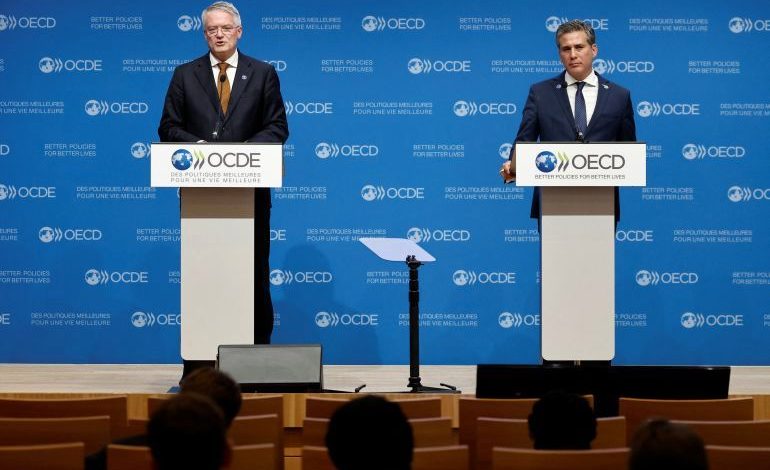
According to the Sedaye Sama News Agency, The Organisation for Economic Co-operation and Development (OECD) stated in its latest economic outlook that although the global economy has shown stronger-than-expected resilience to trade shocks, the continuation of tariff policies and the surge in artificial intelligence investment could quickly disrupt this fragile balance. According to Al Jazeera, the report portrays a world where growth continues but policy and financial risks are steadily rising.
The OECD says that the boom in AI investment has helped offset part of the negative effects of U.S. tariff hikes, allowing global growth to remain around 3.2% in 2025, before dipping slightly to 2.9% in 2026 and rising again to 3.1% in 2027. However, any new wave of trade tensions could threaten this trajectory and may even trigger a “significant market correction” if investor optimism around AI weakens.
Mathias Cormann, the Secretary-General of the OECD, noted that the U.S. tariffs have produced “relatively mild” trade shocks so far, but once corporate inventories run out, the real cost of these policies will become more apparent. The organisation forecasts 2% growth for the U.S. economy in 2025, supported by fiscal spending, AI investment, and expected Fed rate cuts—but pressured by declining immigration, import restrictions, and reductions in government staffing.
At the same time, the OECD warned that President Trump’s fiscal path is “unsustainable”; large deficits and rising debt will require “substantial adjustment” in the coming years. Combined with trade uncertainty, this could become one of the major global economic risk centers.
Among other major economies, the outlook is a mix of relative stability and gradual slowdown. China is expected to grow around 5% this year, declining to 4.4% in 2026 as fiscal support fades and U.S. tariffs take effect. The eurozone is projected to grow 1.3% in 2025, supported by a resilient labor market and higher public spending in Germany, but tighter fiscal policies in France and Italy will weigh on growth in 2026. Japan benefits from strong corporate profits and investment, though a slowdown is expected in 2026.
Global trade is expected to weaken significantly. Trade growth is forecast to fall from 4.2% in 2025 to 2.3% in 2026 as the full impact of tariffs on investment and consumption becomes visible. Persistent uncertainty in trade policy will remain a structural barrier to restoring trade dynamism.
Despite tariff-driven price pressures, inflation in most major economies is expected to return to central bank targets by mid-2027. The U.S. Federal Reserve may cut rates slightly before the end of 2026, unless a new wave of tariff-induced inflation emerges.
The outlook shows that while the global economy continues to grow, it does so in an environment filled with policy and financial risks that require careful management and close coordination among major economies.
Source: Donya-e-Eqtesad