

The Chabahar–Zahedan railway is considered one of the country’s most strategic and fundamental infrastructure projects, aimed at expanding the national rail network, enhancing transport connectivity, and strengthening Iran’s role as a regional transit hub.
This rail route links southeastern Iran and the port of Chabahar to the country’s central and northeastern regions, serving as a vital corridor for facilitating the movement of goods and passengers on both domestic and international routes. Once operational, it will reduce transportation time and costs while improving access to domestic and export markets for the provinces of Sistan and Baluchestan, Khorasan, Hormozgan, and central regions.
One of the project’s key advantages is the creation of a direct route for the North–South rail corridor, connecting Iran to the international transport network and its northern neighbors. This corridor can serve as an alternative route for cargo transport between Persian Gulf countries and Central Asia, easing pressure on congested roads and increasing Iran’s rail transit capacity. The project will also generate direct and indirect employment and significantly support economic growth in southern and eastern regions.
From an infrastructure perspective, the Chabahar–Zahedan railway includes tunnels, special bridges, rail stations, and extensive earthworks and track construction. It is being fully implemented using domestic engineering expertise, demonstrating Iran’s strong technical capabilities and reducing reliance on foreign resources.
According to the CEO of the Construction and Development of Transportation Infrastructures Company, the project’s current value is estimated at approximately $1.5 billion, and the fourteenth administration has made its funding and accelerated implementation a top priority.
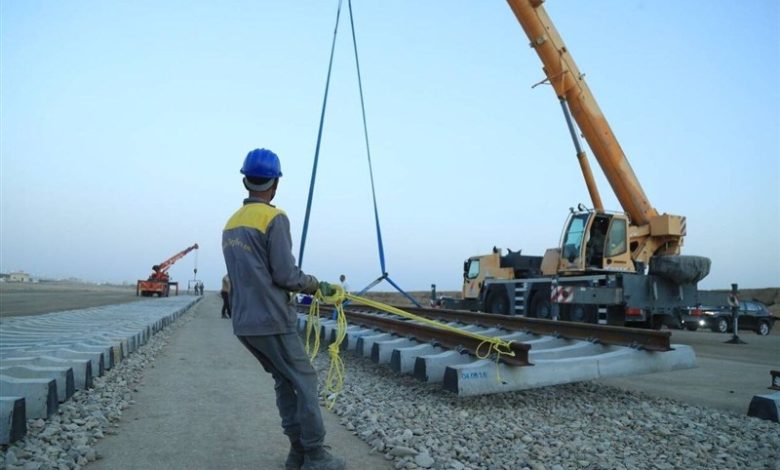
Tasnim News Agency reports that physical progress has reached 96% in substructure works, 76% in track laying, and 48% in station buildings. In the Khash–Iranshahr section, substructure progress stands at 99% and track laying at 95%, while construction of the main Iranshahr station building is 98% complete. Overall station area works, covering 5,260 square meters, have reached 90% completion.
As part of the project, 17 kilometers of tunnels and 20 kilometers of special bridges are being constructed using domestic expertise. Earthworks exceed 70 million cubic meters, and concrete pouring amounts to 2.5 million cubic meters.
Notably, around 90,000 tons of domestically produced rails—equivalent to approximately 450 kilometers of railway track—have been used in the project.
Last Thursday, the Minister of Roads and Urban Development stated that the Chabahar–Zahedan railway, which had remained on the agenda of successive governments for years, entered the execution phase following the Supreme Leader’s emphasis and the persistent efforts of the fourteenth administration.
Sadegh Malavajerd added that more than 350 kilometers of track have been laid in less than a year, reflecting the high technical and operational capacity of domestic engineers and workforce.
Highlighting the project’s rapid pace and record track-laying speeds of up to five kilometers per day on some days, the minister stressed that the project will have wide-ranging economic and social impacts for Sistan and Baluchestan Province and the country as a whole.
He emphasized that development of Chabahar Port, job creation, and strengthening regional transport infrastructure are among the project’s key outcomes, noting that over 90% of substructure works at Shahid Beheshti Port have been completed and that rail connection to Chabahar is targeted by the end of the year.
According to Tasnim, beyond its economic and transportation benefits, the Chabahar–Zahedan railway has the potential to achieve balanced regional development in southeastern Iran, expand investment, industrial, and commercial opportunities for the private sector, and enhance Iran’s geopolitical and economic role by connecting it to international markets. / Tasnim