

Washington’s Costly Game with Tehran
The Conversation reported that amid rising regional tensions, the current unstable situation is closer to the concept of brinkmanship than to genuine preparations for war. Brinkmanship succeeds only if a state can achieve its objectives without becoming embroiled in full-scale conflict. According to the outlet, Donald Trump’s political history is central to understanding this interpretation, as his campaign promises in both 2016 and 2024 focused on ending America’s long and “endless” wars.
A confrontation with Iran would represent a clear example of such costly and protracted wars. Many warn that a full-scale conflict with Iran would drag the entire region into a prolonged confrontation. Consequently, any direct military clash between the United States and Iran could not only result in a military stalemate for Washington but also trigger a severe shock to the global energy economy. For the United States, achieving clear battlefield superiority or victory over Iran would be far from guaranteed. For a figure like Trump, whose political brand is built on external deterrence and internal disruption, a war with Iran would fundamentally contradict his foreign policy objectives.
The Conversation added that Iran’s political and military structures have long prepared for confrontation. Since the 1979 revolution, Tehran’s military doctrine and foreign policy have been shaped around survival under external pressure and attack. Over recent decades, Iran has invested heavily in asymmetric capabilities, including ballistic and cruise missiles, allied regional forces, cyber operations, and anti-access strategies such as air defenses, naval mines, fast attack boats, and drones. Rather than seeking direct confrontation with a power like the United States, Iran has focused on deterrence and preventing external threats from reaching its borders.
For this reason, comparing current U.S.–Iran tensions to Iraq in 2003 is misleading. Unlike Saddam-era Iraq, Iran is geographically larger, more populous, and far better prepared militarily. A direct military strike on Iran would not collapse the political system but would instead activate defensive layers specifically designed for such scenarios. In other words, the key challenge for the United States is not starting a war but sustaining it. In this context, The New York Times reported on January 30 that Trump is under significant pressure to take military action against Iran, though it remains unclear whether he will yield to these demands.
The costs of conflict with Iran
U.S. wars in Iraq and Afghanistan—when reconstruction, veterans’ care, and related expenses are included—have cost between $6 and $8 trillion to date. These conflicts lasted for decades and proved far more expensive than initially anticipated. A potential conflict with Iran, which possesses greater military and defensive capabilities than either country, would not only impose similar costs but could severely drain the already debt-burdened U.S. economy.
The United States is also engaged in intense competition with powers such as Russia, India, and China. Massive global investments in technology and artificial intelligence have heightened concerns in Washington about falling behind. A war in the Middle East could further weaken America’s economic competitiveness, particularly against China. Moreover, Iran’s strategic location at the crossroads of global energy routes could work against Washington. An attack on Iran could disrupt energy flows through critical chokepoints such as the Strait of Hormuz, driving global oil and energy prices sharply higher.
A different form of escalation
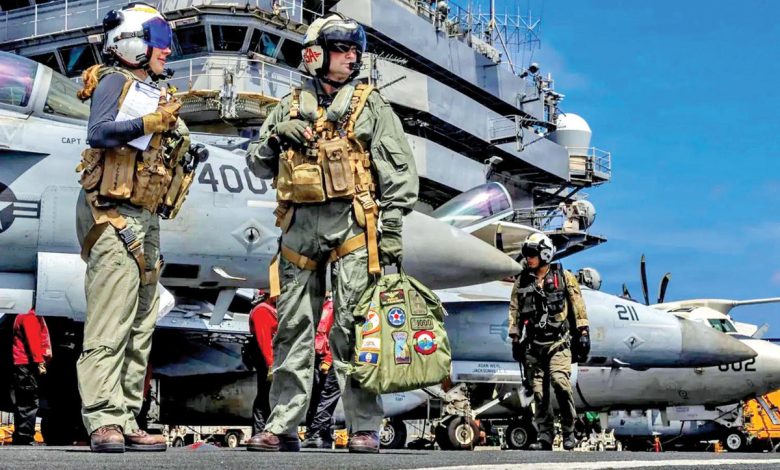
Along similar lines, Asharq Al-Awsat reported on January 29 that it remains uncertain whether current tensions will escalate into a full-scale war. The London-based newspaper noted that the nature and scope of these tensions differ markedly from earlier episodes over the past year. Recent U.S. actions reflect a combined defensive-offensive posture, presenting Washington with multiple scenarios and options. The deployment of aircraft carriers and various defense systems around Iran primarily signals readiness both to strike and to counter any Iranian response.
The newspaper added that Washington understands it cannot expect intervention in the Middle East to proceed as easily as hypothetical operations such as seizing Venezuela’s president, Nicolás Maduro. Iran’s geopolitical complexity and defensive capabilities far exceed those of countries like Venezuela, even if the United States chooses to overlook this reality. The report suggested that uncertainty itself may be part of psychological warfare aimed at pressuring Tehran into accepting Washington’s terms.
Ongoing diplomatic efforts
These developments unfold as neighboring countries seek peaceful alternatives to the current tensions. The Financial Times reported on January 30 that Arab states warned Washington that triggering a conflict would set the entire region ablaze. In the same report, Sanam Vakil, head of the Middle East program at Chatham House, said Iran’s emphasis on diplomatic options shows its desire to buy time and prevent a slide toward irreversible escalation. However, she added that Tehran believes Washington seeks not negotiation but submission.
The Financial Times also noted that deep mistrust among Iranian officials toward the United States and its proposals persists, particularly after Iran was attacked in June amid Omani-mediated talks involving Israel and the United States. Meanwhile, Alhurra TV reported that Gulf states fear any conflict could spill over into their territories, believing that despite Trump’s rhetoric, they would ultimately bear the costs of a prolonged and wide-ranging war.
Taken together, these factors suggest that preventing such outcomes requires restraint, diplomacy, and recognition of the serious risks hanging over the region. Whether rationality will prevail over escalation remains an open question—one that forthcoming developments in the Middle East will soon answer.