

Behind the Conditional U.S. Withdrawal from Two Military Bases in Syria
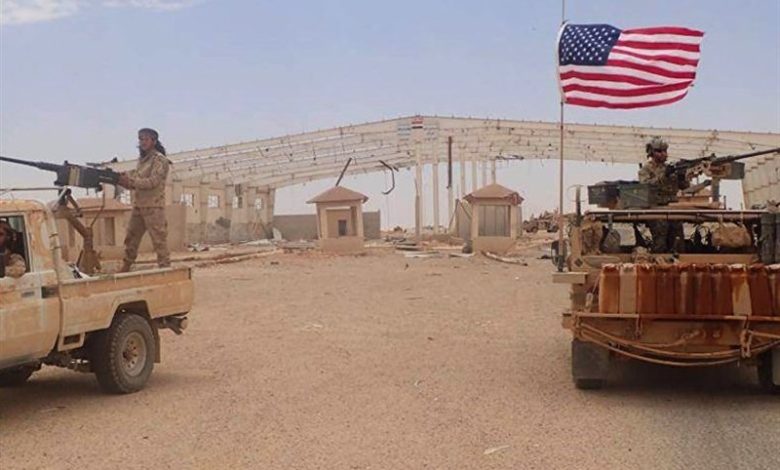
While reducing the U.S. military presence in Syria has been a major topic in regional and international media over the past months, the U.S. apparently began taking steps in this direction several days ago. After U.S. forces withdrew from the Al-Tanf base in the Syria-Iraq-Jordan border triangle over the past three days, the Ministry of Defense of the Abu Muhammad al-Julani government announced on Sunday that its forces, after coordination with the U.S., took control of the military base “Al-Shaddadi” in the countryside of Al-Hasakah.
Reports indicate that U.S. forces transferred their equipment from Al-Shaddadi base to Erbil (Iraqi Kurdistan) and evacuated the base.
The Syrian Observatory for Human Rights reported that Americans burned some facilities and equipment after withdrawing from parts of the base, with columns of smoke visible alongside military movements around the base.
However, U.S.-led coalition forces remain at other positions in northeastern Syria, including the Kharab al-Jir base in the Rimelan area and a site in Qasr, raising further uncertainties about the future of U.S. military presence in northeastern Syria.
Regarding whether the withdrawal from these two bases and handing them over to al-Julani’s government signifies a complete U.S. exit or a reduced military role in Syria, analysts suggest that this step primarily reflects efforts to reduce military costs. Washington seeks to maintain control over Syria through proxy forces, especially since al-Julani’s government is entirely dependent on the U.S.
Other coalition forces under U.S. leadership remain in areas vacated by American troops. Effectively, Washington has handed over some areas to al-Julani’s government under recent agreements, while maintaining full oversight to protect its security and geopolitical interests.
For example, the Al-Tanf base, located in a vast desert area, incurred high logistical costs, yet the U.S. maintained it due to its strategic location. Despite claims that Al-Tanf was a key center for coalition operations against ISIS, many ISIS leaders were trained there, brought from SDF detention centers in Deir ez-Zor and Hasakah.
Al-Tanf was essentially the planning hub for most coalition operations against the Syrian Arab Army and its allies in Deir ez-Zor and the Syrian desert during Bashar al-Assad’s rule and was repeatedly targeted by drone and missile attacks from allies of the previous Syrian government.
With the rise of al-Julani’s U.S.-aligned government, Washington no longer sees a need to bear high costs to maintain Al-Tanf, especially as Russian influence around the base has decreased, focusing instead on Syria’s coastal bases in Tartus, Jableh, and Latakia.
Behind the Conditional U.S. Withdrawal from Syrian Bases
Additionally, the al-Julani government has allowed the U.S. to occupy bases near Damascus, and the al-Julani regime has not denied reports of American intentions to use military bases near the capital.
The U.S. statement issued 24 hours after completing the withdrawal from Al-Tanf is also vague, leaving unclear whether the withdrawal is permanent or merely temporary. The brief statement said that on February 11, U.S. Central Command completed, as part of a “deliberate and conditional transition,” an orderly withdrawal from Al-Tanf base in Syria. The phrase “deliberate and conditional transition” raises many questions about the nature of the U.S. exit from the base.
As noted, after leaving Al-Shaddadi base, U.S. forces transferred their equipment to Iraqi Kurdistan, indicating that there is essentially no exit from the region, and the U.S. is merely repositioning according to its priorities and interests.
Observers believe that the U.S. withdrawal from Al-Tanf and Al-Shaddadi does not signify a reduction of military presence or influence, nor a change in position in Syria; Washington is simply relocating its bases and forces rather than dismantling them.
Evidence shows that the U.S. focuses on more strategic bases in Syria, especially around Damascus. With changes on the ground and the rise of a government fully obedient to Washington, the U.S. no longer sees the need for direct presence in high-risk and costly areas.
Moreover, as the Americans themselves emphasize, this is a conditional withdrawal, reflecting a shift in Washington’s approach to Syria. Having long relied on strict economic sanctions and extensive military deployment, the U.S. now seems inclined to adjust its positioning outside Syria, in Jordan and Iraq, while maintaining the ability to intervene if necessary.
This suggests that the U.S. withdrawal from several Syrian bases is more of a tactical adjustment than a final exit closing the chapter of American influence in Syria. Americans also emphasize direct coordination with the al-Julani government in handing over the bases according to shared priorities, raising questions about the real independence of al-Julani’s regime in security decisions and its ability to convert situational cooperation into a purely national sovereign achievement.
Managing Military Presence Instead of Ending Occupation
Elias al-Mur, a regional military expert, stated that handing over Al-Tanf and Al-Shaddadi bases to the al-Julani government does not signify the end of U.S. military presence in Syria, but rather a redistribution of American and coalition forces under a revised strategy.
He added that the U.S. withdrawal from Syrian bases cannot be seen as a complete exit; it is a planned relocation reflecting a change in approach to managing presence, not its termination.
The Arabic-speaking expert emphasized that the actual U.S. presence remains focused on eastern and northeastern Syria through small bases and support and coordination points, particularly in Hasakah and the eastern Euphrates, along with unannounced intelligence presence in sensitive areas, including Qamishli.