

Iran’s sky will host the brightest comet of the year
The spokesperson for the Amateur Astronomy Committee of the Iranian Astronomy Society announced that the comet Lemon will approach the Earth and the Sun in late October and early November, reaching its peak brightness and becoming visible to the naked eye in Iran’s sky.
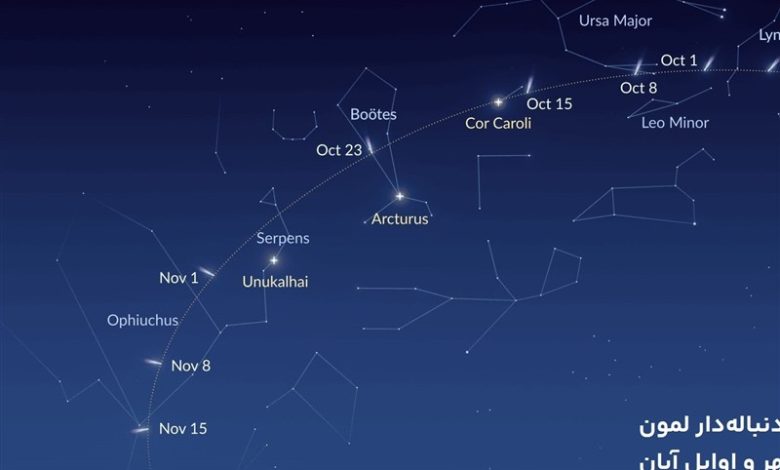
According to the Sedaye Sama News Agency, Kazem Kokaram, spokesperson for the Amateur Astronomy Committee of the Iranian Astronomical Society, announced that during the final nights of Mehr (mid–October) and the first half of Aban (late October to early November), the comet “Lemmon” (C/2025 A6) will reach its peak brightness and become visible to the naked eye in Iran’s sky. The comet is currently approaching both the Earth and the Sun; it will reach its closest distance to Earth on October 20 (29 Mehr) and its closest approach to the Sun on November 7 (17 Aban).
He explained that Comet Lemmon was discovered on January 3, 2025 (14 Dey 1403), being the sixth comet discovered in the first half of January that year. Based on orbital calculations, it orbits the Sun once every 1,350 years, and the last time it passed near the Sun was about 1,350 years ago.
Kokaram noted that the comet’s brightening trend is promising, and it is expected to become visible to the unaided eye during the first half of Aban. At present, it lies at the threshold of naked-eye visibility but can easily be observed using binoculars or small telescopes, though confirmed naked-eye observations have not yet been reported.
In terms of position, the comet is currently located near the constellation Canes Venatici, beside Ursa Major, and in the coming weeks, it will move toward the constellations Boötes and Serpens, becoming an evening-sky object.
According to Kokaram, Comet Lemmon will likely be the brightest comet of 1403 (2024–2025) for Iranian observers. Its name derives from the Mount Lemmon Survey project, a telescope program dedicated to detecting near-Earth objects such as asteroids and comets, which has discovered several notable comets in recent years.
He emphasized that the correct term for these celestial bodies is “comet,” not “shooting star,” since they do not generate their own light but reflect sunlight.
Kokaram explained that comets are composed of ice and rock, and as they approach the Sun, heat causes part of their ice and dust to vaporize, forming a tail that points away from the Sun. The nucleus of a comet typically ranges from about one to thirteen kilometers in diameter.
He concluded by recalling that previous comets such as “Souchinshan–ATLAS” (2024) and “NEOWISE” (2020) were also visible in Iran’s skies to the naked eye, but Comet Lemmon is expected to be this year’s brightest and most likely to be seen without instruments.