

Sudan — the hell of fighting!
 Hawraa al Massri
Here, inside a dark room in one of Sudan’s conflict-ravaged areas, sits a Sudanese woman in silence, sobbing as tears burn down her cheeks.
Yes, the unthinkable happened — she was robbed of her most precious possession: her honor. All of it took place before the eyes of her children, none older than six.
This is the reality Sudanese women and girls live through: sexual assault has become a common practice, even a point of pride among these killers — the Sudanese Rapid Support Forces (RSF).
Today, Sudan faces one of the darkest chapters in its modern history. Since fighting erupted between the Sudanese army and the RSF, thousands have been killed, and tens of thousands displaced both inside and outside the country. The destruction has gone far beyond lives — infrastructure, hospitals, and major cities like Khartoum have been devastated.
Sudanese citizens now endure a man-made famine — a calculated deprivation imposed by militias.
Sudan’s Reality: Who is Fighting Whom?
The conflict pits two main sides:
-
The Sudanese Armed Forces (SAF), the official army of the state.
-
The Rapid Support Forces (RSF), a semi-militia group backed by internal and external powers.
The clashes began on April 15, 2023, marking the start of a brutal civil war.
After the fall of former president Omar al-Bashir, both forces briefly shared power through the Transitional Sovereign Council, but tensions escalated when the issue of integrating the RSF into the national army arose.
RSF commander Mohamed Hamdan Dagalo (Hemedti) rejected this plan outright. Bolstered by external support and advanced weaponry — drones, vehicles, and arms — the RSF dragged Sudan into a protracted war of attrition.
This raised a critical question: who is arming them? Many reports, particularly from The New York Times, pointed fingers at the United Arab Emirates (UAE).
The RSF’s Regional and International Support: The UAE as an Example
Several Western reports suggest that the UAE supplied the RSF with advanced weapons and coordinated with regional allies in Chad, Libya, and Ethiopia to expand its influence.
Analysts say the motive is largely economic — Abu Dhabi has invested in nearly 50,000 hectares of Sudanese farmland, exposing its interest in controlling Sudan’s vast resources.
Meanwhile, Egypt and Saudi Arabia have acted as mediators with a slight inclination toward the Sudanese army, while Qatar and Turkey have kept limited political roles.
When Humanity Dies in an Instant
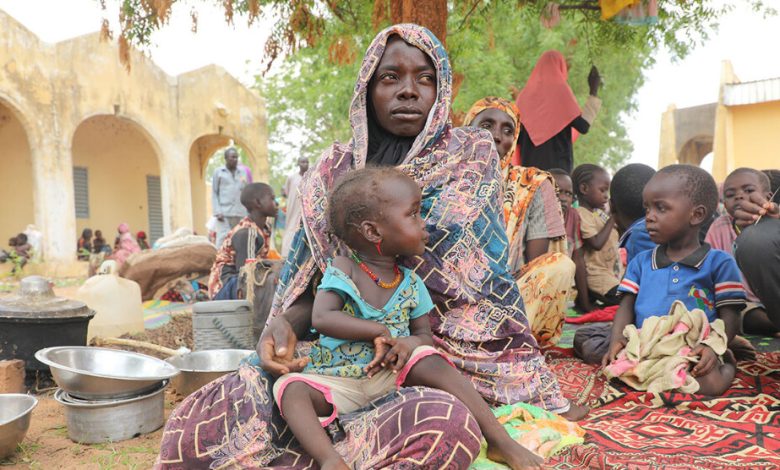
The humanitarian situation in Sudan is nothing short of catastrophic.
When children are murdered and women’s dignity violated without shame or restraint, humanity itself dies.
Tens of thousands of Sudanese flee toward the unknown, sleeping under the open sky in deserts, stripped of food, shelter, or hope — especially in Khartoum and El-Fasher, where mass displacement continues.
When a group of armed men, terrorists in every sense of the word, record their massacres and brag about them online, you know the Arab and Muslim conscience has been buried.
El-Fasher — The Army’s Last Stronghold and the RSF’s Pressure Card
El-Fasher, located in the Darfur region, is a key strategic area linking western Sudan to the north and center.
The city has endured more than 500 days of siege, without food, water, or electricity. The RSF seeks to capture El-Fasher to isolate it from the rest of Sudan.
The atrocities committed there have finally forced the international community to reopen the Sudan file. The European Union has pledged to support the International Criminal Court (ICC) in gathering evidence and prosecuting those responsible.
The tragedy unfolding in El-Fasher echoes the horrors of early 2000s Darfur — the same massacres, the same displacement, and now, once again, the same global silence.
Sudan Cries Out to the Islamic World
What’s happening in Sudan is not merely a political conflict — it’s a crime against both faith and humanity.
God has honored humankind — yet in Sudan, Muslims are being slaughtered in the most barbaric ways, their deaths filmed and spread across social media.
What is happening in Gaza and Sudan is a divine test for this silent nation.
What’s even more painful is that much of this bloodshed occurs with the support of an Arab, Muslim state.
So, where is Islam in all this?
Is this truly the same religion we follow — the Islam that honors women and upholds human dignity?
When women are assaulted publicly, before the eyes of the world, it becomes clear: this is not Islam — this is barbarism hiding beneath the cloak of religion.