

The “Trump Route” Project in the Caucasus: The Zangezur Corridor in New American Packaging
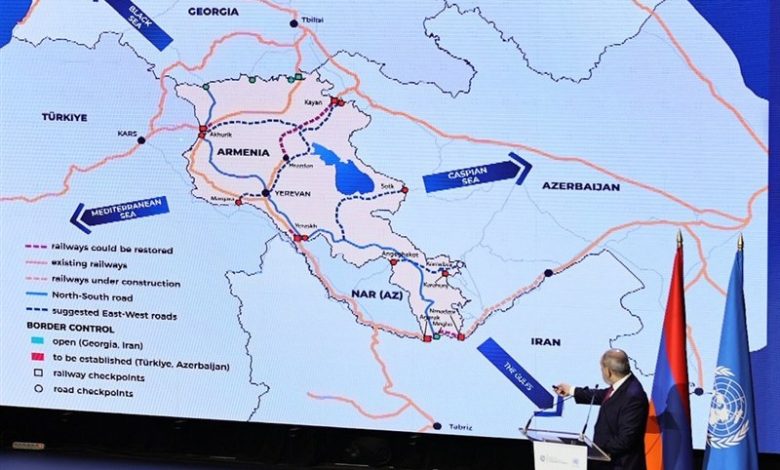
According to the Sedaye Sama News Agency, In recent days, diplomatic and media activity in the South Caucasus has intensified, once again revolving around the controversial keyword “Zangezur Corridor.” This time, the project has re-emerged under a new label: “The Trump Route for International Peace and Prosperity” (TRIPP). Evidence shows that the United States is attempting to pursue its hegemonic goals along Iran’s northern borders and Russia’s sphere of influence by simply rebranding the initiative.
Georgia: The New Link in the Chain of Western Influence
According to reports, Tbilisi recently hosted two important delegations: Armenian President Vahagn Khachaturyan, and a U.S. State Department delegation led by Jonathan Askonas. The central topic of discussions was the geopolitical implications of opening the Zangezur Corridor and launching the U.S.-backed TRIPP initiative.
These moves come despite Iran’s repeated warnings against any geopolitical change that could cut its access to Armenia. Nevertheless, Washington appears determined to engage Tbilisi as part of a broader effort to complete its geopolitical encirclement strategy in the Caucasus.
Georgian Experts: Support Mixed with Concern
Regional media gathered comments from several Georgian political analysts.
Tornike Shalashenidze, Dean of the School of International Relations at the Georgian Institute of Public Affairs, declared that Tbilisi fully supports both the Zangezur Corridor and the TRIPP initiative.
Citing remarks by Armenian Prime Minister Nikol Pashinyan, he revealed a plan with clear neo-colonial implications:
“A joint company will be established and run by a board of directors composed of Armenian and American representatives. Georgia could join this format as a regional actor and security guarantor—something Washington encourages.”
This clearly indicates a U.S. goal of placing regional strategic routes under the control of external actors.
Acknowledging Security Risks and Regional Opposition
Another expert, Giorgi Gagua, who attempted to portray the corridor as a peace-building mechanism, was nonetheless forced to acknowledge several realities:
-
Russia and Iran view the Zangezur Corridor as a strategic threat.
-
Internal instability in Armenia is likely due to domestic opposition.
-
Parts of Georgian society worry that their country may lose its strategic transit role.
He noted that the visit of the senior U.S. official aimed to reassure Georgia and upgrade relations with Washington to ease fears of reduced transit traffic.
Corridor Competition: Economic Promise or Political Illusion?
Zaal Kasrelishvili, head of the Confederation of Caucasian Nations, stated that branding the project as “The Trump Route (TRIPP)” offers psychological appeal in the West, but does not eliminate the traditional Baku–Tbilisi–Kars corridor.
He argued that although Zangezur will introduce real competition, Georgia can remain a key player if it improves its services and fees—especially given its direct access to European ports via the Black Sea.
He also highlighted a crucial point that could undermine pan-Turkic aspirations:
“Routing Chinese goods through Zangezur strengthens China’s rival (Turkey). Thus, for Beijing, the Georgian route remains more cost-effective. Zangezur may appeal to Turkic Central Asian states, but Baku–Tbilisi–Kars remains vital for other powers.”
Strategic Assessment
Overall analysis indicates that the so-called TRIPP project is essentially an attempt by the United States to revive NATO’s failed strategy in the Caucasus by:
-
Marginalizing Iran and Russia from regional transit routes.
-
Increasing Armenia’s dependency through U.S.-Armenian joint management structures.
-
Disrupting regional cooperation frameworks such as the 3+3 format by fostering rivalry and distrust.
source: tasnim