

Seventh Development Plan: Creating USD 91 Billion in Non-Oil Exports Over Five Years
Iran’s Capable Private Sector Is the Key to Saving the Country’s Non-Oil Exports
 Habibeh Rahimiyan, reporter for Sadaye Sama
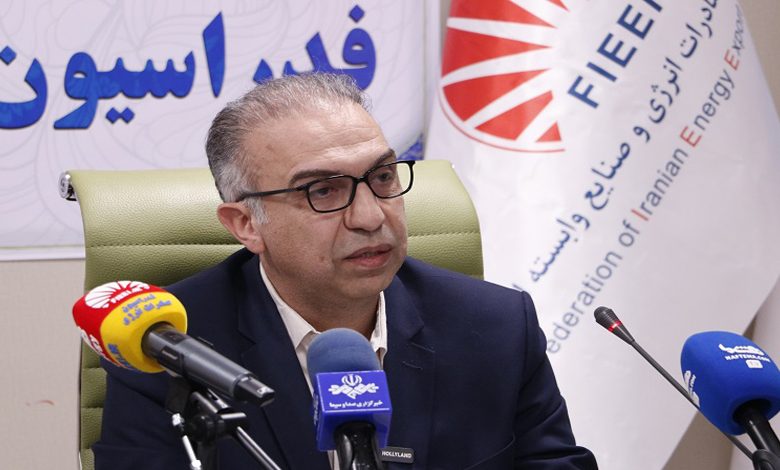
The Vice Chairman of the Iran Energy Export Federation and Related Industries stated that Iran must create USD 91 billion in new non-oil exports over five years, but seven-month customs data show that the country’s current exports amount to only USD 32 billion—a figure that, according to Jamshid Khalilzadeh, is at least USD 21 billion below the targets of the Seventh Development Plan.
According to the Sedaye Sama News Agency, Jamshid Khalilzadeh, Vice Chairman of the Federation’s Board of Directors, addressed the challenges and solutions for developing Iran’s non-oil exports at a press conference titled “Obstacles to the Development of Non-Oil Exports in the Energy Sector.”
Referring to the two main pillars of non-oil exports—energy exports (petroleum products and the energy sector) and technical and engineering services exports—he said:
“The biggest challenge facing Iran’s non-oil exports today is the limitation in production capacity.”
Khalilzadeh emphasized that over the past two decades, due to sanctions and reduced cooperation with friendly countries, Iran’s energy production capacity has been severely constrained, to the point that it sometimes fails to meet even domestic demand.
He added:
“For export development, production must be the main pillar. However, the government’s capacity to invest in this sector is limited. Banks, domestic institutions, and funds are also unable to provide the necessary financing. The only viable path is attracting foreign investment.”
Stressing the importance of empowering the private sector, he said:
“If the government creates a supportive framework for the private sector instead of direct spending, foreign investment can be attracted and production increased. Fortunately, Iran has a capable private sector and a creative population that has proven successful in areas such as petrochemicals.”
Focusing on the Seventh Development Plan, Khalilzadeh explained:
“The plan has two major strategic objectives: a 23 percent growth in non-oil exports and an 8 percent growth in GDP.”
He noted:
“With a base of USD 50 billion in exports in 2023, the target for the final year of the plan is USD 141 billion—meaning the creation of USD 91 billion in new exports over five years.”
He continued:
“According to World Bank data, Iran’s GDP in the base year of the plan was USD 405 billion. With an 8 percent growth rate, this figure should reach USD 595 billion. Of the USD 190 billion increase, policymakers have planned for USD 91 billion to come from non-oil exports.”
He concluded:
“These figures clearly show that export development is the core strategy of the Seventh Development Plan.”
Referring to actual performance, Khalilzadeh said:
“According to the plan, exports should have reached USD 75 billion in 2025. However, seven-month customs data show only USD 32 billion, and even under the most optimistic scenario, exports this year will not exceed USD 54 billion—indicating a shortfall of at least USD 21 billion.”
He identified production constraints as the main obstacle to exports, stating that energy production has become so limited that it sometimes fails to meet domestic consumption, while the government, banks, and funds lack the capacity for new investments.
He emphasized:
“The only remaining path is strengthening the private sector and attracting foreign investment—even under sanctions—through mechanisms such as offtake agreements, provided that the government acts as a guarantor rather than a competitor.”
As a member of the Board of Directors of the Association of Engineering and Technical Services Exporters, Khalilzadeh also highlighted Iran’s capabilities in this field, saying:
“Iranian companies have strong capabilities in oil, gas, road construction, and building sectors, and to date, they have exported over USD 50 billion worth of technical and engineering services to nearly 100 countries. With greater support for the private sector, this figure can increase significantly.”
He added that this sector could be one of the fastest sources of foreign currency inflows, provided that policymakers offer adequate support.
Khalilzadeh concluded by stressing that the government no longer has the capacity to finance large-scale production projects, and that the only remaining solution is empowering the private sector and attracting foreign investment, supported by government-backed guarantees and offtake agreements.