

Secrets of the longest night of the year / Why do Iranians gather together on Yalda Night?
From this perspective, Nowruz can be regarded as a kind of agricultural festival held at the beginning of the season and the renewal of the year. Viewed this way, some of our ancestors considered Yalda Night an agricultural celebration and the start of a new season. Since farmers’ work ended in autumn, they celebrated the end of that season and the beginning of winter—a period of rest and leisure from agricultural labor. Thus, from a seasonal and agricultural standpoint, Yalda is a festival marking the transition from one season to another.
With this introduction, the Shahnameh scholar examines Yalda from a newer angle, namely its ritual and belief-based dimensions. He explains that the word Yalda is of Syriac origin; the Syriacs were an ancient Semitic people, and the word means “birth.” Words used in Arabic and subsequently in Persian—such as wiladat (birth), mawlud (newborn), tawallud (birth), walid and walida (father and mother)—share the same root as Yalda. This raises the question: why was this night called the night of birth? Whose or what birth was being celebrated?
According to Aidenloo, our ancestors believed that the last day of autumn, the 30th of Azar, marked the annual rebirth of the sun. They believed that the sun, which had been captive in darkness for several months, was born anew on this night—the final night of autumn—and thus celebrated its birth. This is why the night came to be called Yalda. He adds that the night is also known as Shab-e Chelleh.
The word Chelleh derives from chehel (forty). Forty days after the 30th of Azar falls the 10th of Bahman, when the ancient Iranian festival of Sadeh was celebrated. Thus, the sun born on Yalda Night reaches forty days of age on the 10th of Bahman, and the Sadeh festival marks its growth and maturity. From this perspective, Yalda is the night when a newborn—the sun—is born, and forty days later, during Sadeh, it is formally revealed to all. This further confirms the linguistic and ritual connection between Yalda and the birth of the sun.
The scholar also notes that Yalda is linked not only to the sun but also to Mehr (Mithra). Contrary to popular belief, Mehr does not mean the sun. In ancient Iranian beliefs, Mehr was the deity of light who observed the world before sunrise and descended to earth after sunset to oversee the faithful observance of covenants. Hence, Mehr was known as the god of oaths and contracts. He cites the Avesta, which praises Mehr as the first divine being to rise before the immortal sun.
Aidenloo adds that in the pre-Islamic Iranian calendar, the 11th day of each month was dedicated to the sun, while the 16th day was dedicated to Mehr, showing their distinction. He explains that before Zoroaster, Mehr was worshipped as a god, but later his status diminished. In Europe, particularly Rome, Mithraism was widespread, and remains of Mithraic temples can still be found.
He then turns to regional legends, noting that many Iranian folk tales center on the sun. In Luristan, for example, legends say the moon was in love with the sun, but always fell asleep before dawn. On the 30th of Azar, however, the moon stayed awake, leading to a longer night—Yalda. Other legends describe battles or covenants between Mehr and the sun, or demons stealing the sun, prompting people to light fires and candles to help free it from darkness.
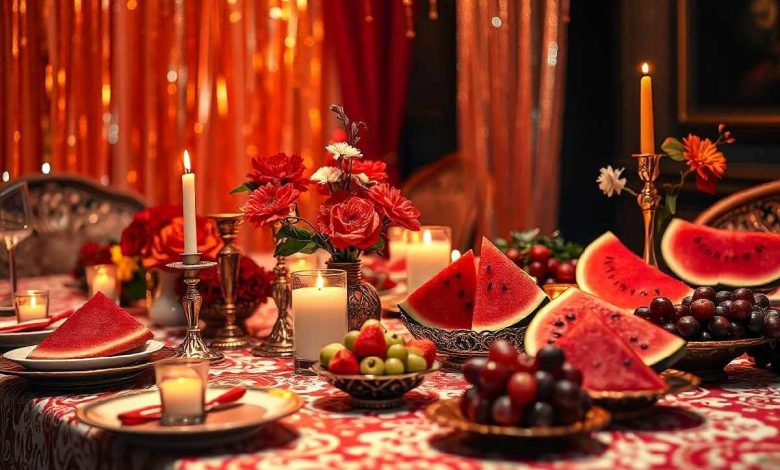
The scholar emphasizes that the sun’s central role in these legends explains why Yalda is celebrated and congratulated—it is essentially a birthday celebration of the sun. He then discusses Yalda customs such as spreading a special table, with watermelon as the central symbol, representing the sun and its light.
He also describes prayers, poetry readings, Shahnameh recitations, folk songs, fire rituals, and regional customs across Iran, all reflecting themes of renewal, light, and hope. Finally, he notes Yalda’s deep presence in Persian literature, citing verses by Ferdowsi, Saadi, Hafez, and others, demonstrating the enduring cultural significance of the longest night of the year./ Donyaye Eghtesad