

When oversight is labeled “anti-consensus”: the story of a speech and the reactions
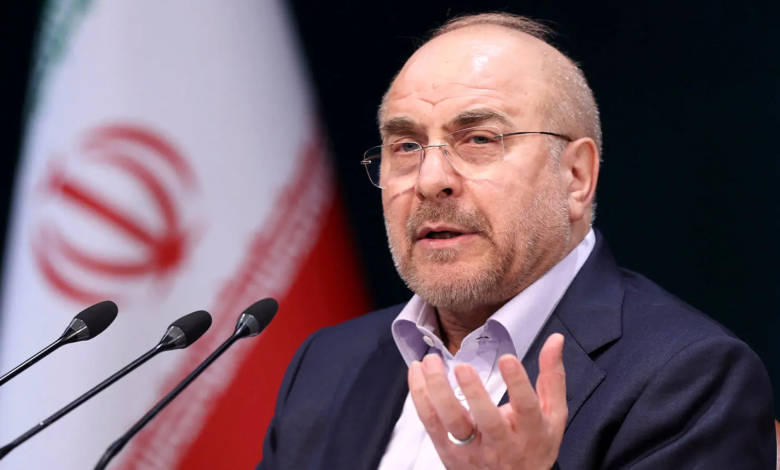
One day after Mohammad Bagher Ghalibaf’s speech in the open session of parliament addressing recent price hikes, a significant number of media outlets and newspapers close to the reformist camp launched a relatively coordinated attack on the Speaker of Parliament.
The newspaper Sazandegi criticized his remarks under the headline “Ghalibaf’s Intervention,” while Etemad responded with the headline “Consensus Under Fire.” This came even as the same speech subjected Ghalibaf to pressure from a group of hardline MPs, who oppose giving the government any time and openly call for the immediate launch of impeachment proceedings.
1- In his pre-agenda speech during the Sunday plenary session on December 21, 2025, Ghalibaf focused on public livelihood concerns, warning about runaway inflation in essential goods, particularly the rising prices of foreign currency and gold. He stressed that parliament has been and will continue to seriously pursue the issue.
He announced a supervisory session with economic ministers and relevant officials, stating that if corrective measures fail to deliver results, priority would be given to cabinet reshuffles by the government to achieve results with the least time and tension. If necessary reforms are not implemented, MPs would be forced to initiate impeachment procedures.
This framework effectively outlined a roadmap: first, reform from within the government; if that fails, parliamentary oversight tools would come into play.
The main criticism from some media outlets is why the Speaker “threatened” the government or used terms such as reshuffle or impeachment. However, the logic of governance is clear: impeachment in Iran is not a punitive tool but a mechanism to enforce accountability and course correction. Granting the government time amid economic turbulence is not appeasement; rather, it can help resolve issues with minimal social cost and political tension—precisely what Ghalibaf meant by “the least time and the least tension.”
In other words, if parliament immediately resorts to repeated impeachments, the government enters a constant defensive mode, diverting national energy from problem-solving to political confrontation. A short, transparent, results-oriented deadline is a more rational approach, allowing the government to reform internally while parliament sets clear benchmarks.
2- Reformist media outlets often claim that consensus is being undermined whenever the government faces criticism from other branches. Yet no agreement has ever been signed to ignore weaknesses. Consensus, in its true sense, means cooperation to solve problems—not overlooking crises. Throughout various administrations, parliamentary speakers have sought cooperation with governments, which is more visible today due to sensitive conditions and the aftermath of the 12-day war. However, radicals on both sides try to pit consensus against oversight, portraying any supervisory pressure as anti-consensus.
If consensus is interpreted as silence in the face of currency devaluation, inflation, and livelihood pressure, it effectively becomes political collusion.
In his speech, Ghalibaf framed the issue as a public concern and emphasized parliamentary follow-up. The dispute is not over the existence of the problem but over how to address it. Parliament has so far chosen cooperation, oversight sessions, and a deadline for reform, but as inflation and price surges persist, it cannot remain a passive observer.
3- Ghalibaf faces pressure not only from reformist media but also from hardliners within parliament who fundamentally oppose giving the government time. A notable example is the MP from Khomeinishahr, who sharply criticized Ghalibaf in a verbal objection, calling for an end to ultimatums and demanding that impeachments be brought to the floor immediately. Similarly, an MP from Qom criticized delays in formally processing impeachment motions.
Caught between these two pressures—media accusing him of threats and MPs calling his approach insufficient—Ghalibaf has nonetheless followed the Supreme Leader’s guidance, which holds that having no official in charge is worse than having one who falls short of some criteria, while recognizing impeachment as parliament’s right. The approach mirrors that taken during the late President Raisi’s administration, when impeachments were delayed in favor of internal cabinet adjustments—a policy now applied to President Pezeshkian’s government as well.
4- Media outlets critical of impeachment or cabinet reshuffles should represent the people rather than political factions, holding the government accountable for economic performance and parliament accountable for the effectiveness of its oversight tools.
Consensus, cooperation, and synergy must never become excuses for overlooking mistakes. When people’s livelihoods are at stake, parliament cannot retreat from oversight, the government cannot replace accountability with media niceties, and the media cannot substitute criticism with exoneration./ tasnim