

The Temptation of a High-Risk War
Jason H. Campbell, senior researcher at the Middle East Institute, wrote in an analysis of the probabilities and consequences of a U.S. military strike on Iran, asking: “Weaker military posture, murkier targets; why is the next strike costlier?”
Given signs pointing to the likelihood of an imminent military strike against Iran, the current situation at least requires a brief assessment of the fundamental factors related to strategic intent, operational options and constraints, and the potential policy consequences of such a course. This analysis examines these issues in the context of attacks carried out by Israel and the United States against Iran in June 2025, during the “Roaring Lions” and “Midnight Hammer” operations, often referred to as the “12-day war.” The study concludes that under current conditions, the military options available to the U.S. are more limited than in mid-last year, the benefits are less predictable, and strategic risks have increased. At the same time, Washington also has non-military options, including inaction—and Trump himself mentioned the possibility of using tariffs to increase pressure on Iran, while the U.S. had previously imposed new sanctions—but these options are beyond the scope of this assessment.
Readiness for Military Action
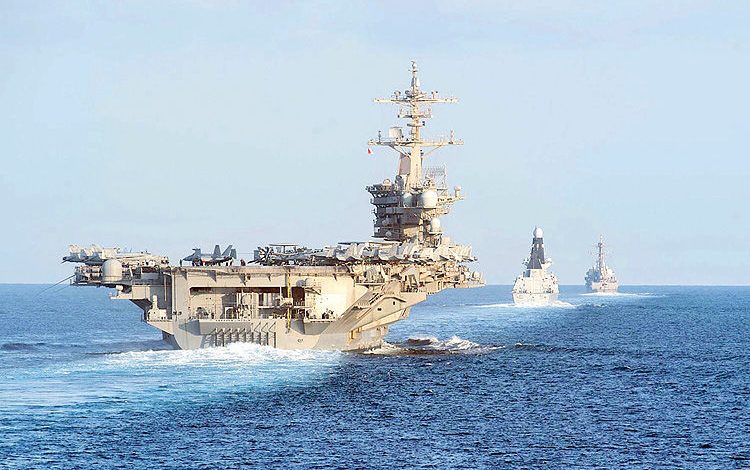
On the eve of the “Roaring Lions” and “Midnight Hammer” operations, the U.S. armed forces significantly strengthened their military posture in the region, increasing both offensive and defensive capabilities. In spring 2025, the U.S. Navy took an unprecedented step by deploying not one but two aircraft carrier strike groups—the USS Carl Vinson and USS Nimitz—to the Arabian Sea. Additionally, an Arleigh Burke-class guided-missile destroyer, the USS Thomas Hudner, was moved from the western Mediterranean to the eastern part of the sea. This fleet, comprising approximately 20 warships, 150 aircraft, and over 15,000 sailors and Marines, represented a significant offensive and missile-defense capability.
In addition, the U.S. Army deployed a Patriot air defense battalion from South Korea to Al Udeid Air Base in Qatar, carried out via 73 C-17 flights, in preparation for potential Iranian retaliatory strikes. Although the main strikes on Iran’s nuclear facilities were ultimately carried out by seven B-2 bombers based in the U.S., the forces stationed in the region played an important support role, including launching Tomahawk missiles from air and sea platforms, intercepting Iranian missiles aimed at Israel and Qatar, and deterring potential retaliation.
Strategic Objectives
After the 12-day war, both Israeli and U.S. officials insisted that regime change in Iran was not an objective, although some largely symbolic Israeli actions appeared to suggest otherwise. The attacks focused on key military targets, including nuclear facilities, air defense systems, ballistic missiles and their launchers, and senior commanders.
Damage assessments indicated that Iran’s nuclear program was delayed by at least several years, air defenses in western Iran were weakened, ballistic missile capacity decreased from roughly 2,500 to 1,000, launchers from about 375 to 125, and 30 senior security commanders were assassinated.
Crucially, according to reports, Israeli Prime Minister Benjamin Netanyahu, during a visit to the White House just before the protests began, proposed additional strikes with a renewed focus on Iran’s military targets. Trump did not take a clear position on this, and no specific plan was approved. Nevertheless, events are progressing rapidly, and recent speculation suggests a potential U.S. strike may again focus on weakening government institutions, reducing military capacity without directly targeting officials or other key political objectives. This approach could preserve Trump’s credibility, avoid opening a “Pandora’s box” of consequences, and potentially extract concessions in future negotiations.
Consequences of the Strike
Another key factor to consider is Iran’s likely response to U.S. attacks. During the 12-day war, Iran launched approximately 550 missiles and nearly 1,000 drones toward Israel, causing significant damage. In response to U.S. actions, Iran fired a barrage of missiles at Al Udeid Air Base.
However, one of the notable costs was the equipment and munitions expended in countering the attack. Given that the U.S., in its current threats to strike Iran, makes no effort to preserve the element of surprise, Tehran has explicitly stated that its response to any new strikes will not be limited, and Iran’s ballistic missile inventory remained significant even before accounting for any replenishment over recent months.
Furthermore, while Iran’s network of regional allies has weakened over recent years, many of these groups have become increasingly desperate as a result of this situation and may now be more prepared to coordinate broader attacks on U.S. interests across the Middle East.
Proceed with Caution
Ultimately, in assessing the risks of any new operation, the U.S. government must also ensure that it has not drawn the wrong lessons from the 12-day war. From the perspective of force disposition and equipment, the U.S. (and Israel) are now less prepared to defend against a state that, while weakened, may see fewer barriers to employing its still-significant ballistic missile capabilities against multiple vulnerable targets across the region.
Furthermore, as events unfold and potentially expand, there is no guarantee that Trump will once again be able to compel all parties—as he succeeded in doing last June—to halt their actions at his behest. Overall, Iran’s decision-making calculations have changed significantly since last June, and any lessons drawn from the 12-day war must be considered in this context. Any subsequent U.S. intervention must clearly specify what it expects to achieve and be measured against the possibility of a disproportionate response.
A Broader Reach from Iran, but the Current U.S. Force Posture in the Region Paints a Different Picture
At the time of Trump’s social media post, U.S. Navy tracking data indicated that all aircraft carrier strike groups were operating either in the Western Hemisphere or in East Asia, thousands of kilometers away from the Middle East. However, on January 15, it was announced that a strike group led by the USS Abraham Lincoln was being directed toward the Arabian Sea, arriving there the following day.
Additionally, the Patriot battalion that had been deployed to defend Al Udeid Air Base prior to the “Midnight Hammer” operation returned to Osan Air Base in South Korea in late October. While some reports suggested this unit would be replaced as part of continuing heightened readiness, this has not yet occurred. As a result, the U.S., at least for now, faces limitations in the scope, scale, and duration of any subsequent strikes. This situation also leaves key regional assets—including U.S. bases and facilities, embassies, and broadly, Israel—more vulnerable to retaliatory attacks.