


Water Security Risk – Part Seven
 Amirhossein Khodaei – Researcher
The Role of Watershed Management in Strengthening Water Security and Sustainable Resource Management
At a time when water scarcity, soil erosion, and devastating floods are threatening the country’s landscape, watershed management represents a smart strategy that goes beyond a purely technical measure. It offers a way to turn floods into opportunities and replenish Iran’s thirsty land. Unlike costly dam-building and water-transfer projects, watershed management initiatives have achieved significant improvements in water and soil sustainability in many parts of the country at a much lower cost.
This approach not only prevents soil erosion and sediment accumulation in dams, but also revitalizes sustainable rural development by increasing groundwater recharge, restoring traditional qanats, and supporting both rain-fed and irrigated agriculture. By relying on indigenous knowledge and community participation, watershed management has created a sustainable bridge between natural-resource management and food security.
Beyond its economic benefits, its environmental achievements are also significant. Increased vegetation cover, habitat conservation, reduced dust and restoration of biodiversity are among the outcomes achieved through this approach. In other words, watershed management is an investment in the future—an investment in land, water, and life.
As one of the fundamental pillars of integrated natural-resource management, watershed management plays a key role in ensuring water security, reducing flood damage, and maintaining the country’s ecological sustainability. In practice, watershed management creates a link between water, soil, and vegetation management and directly contributes to increasing groundwater storage, controlling soil erosion, and reducing sediment accumulation in dams. Given Iran’s arid and semi-arid climate, expanding and adapting watershed-management solutions to local conditions can serve as an effective tool for addressing water scarcity and increasing the resilience of the land.
- Controlling Erosion and Sedimentation in River Basins
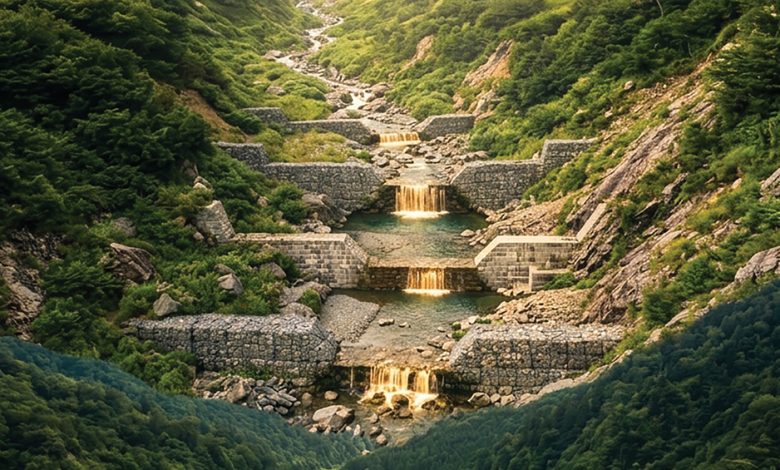
One of the most important challenges in water management in Iran is sediment accumulation in dams and rivers. Watershed-management measures, including planting vegetation in highland areas, stabilizing slopes, and constructing stone-and-mortar structures along flood channels, can significantly reduce the amount of sediment entering reservoirs. This not only extends the useful life of dams but also prevents the annual loss of millions of cubic meters of water.
- Artificial Recharge and Increasing Groundwater Storage
Through flood-spreading projects, construction of earthen, stone, and gabion check dams, and directing surface water toward aquifers, the balance between groundwater extraction and recharge can be improved. These methods are among the most effective natural tools for combating declining groundwater levels in arid regions. Aquifer-recharge projects and underground dams that have been implemented on a pilot basis in different parts of the country can serve as indigenous models for developing natural water-storage capacity.
- Using Simple, Community-Based Structures
Successful watershed management does not require complex or expensive tools. Instead, it can be based on simple, practical, low-cost measures implemented at the local level. Earthen reservoirs, rainwater-storage ponds, crescent-shaped bunds, and small flood-spreading channels are examples of measures that can be implemented with local community participation and collectively play an important role in increasing surface-water storage and reducing erosion.
- Local Community Participation and Public Investment
Experience has shown that wherever local communities have actively participated in natural-resource projects, the success and sustainability of those projects have been greater. Establishing local watershed-management cooperatives, creating village funds for maintaining and repairing structures, and transferring part of resource management to local communities are effective ways to reduce costs and improve project efficiency. Combining indigenous knowledge with engineering expertise can increase water productivity and reduce local tensions over resource use.
- Economic and Environmental Added Value of Watershed Management
Watershed-management activities are not limited to water storage; they can also create sustainable income and employment opportunities for rural communities. Using dredged sediments in construction projects and soil restoration, producing seedlings and rangeland plants, and developing nature-based tourism are among the economic opportunities offered by watersheds. From an environmental perspective, reducing excessive extraction of natural materials, increasing vegetation cover, and restoring aquatic and terrestrial habitats are among the direct benefits of these measures.
- Integrating Watershed Management with Broader Water-Management Policies
Integrating watershed-management policies with national water, agricultural, and environmental programs is unavoidable. Erosion-control, dredging, surface-water storage, and aquifer-recharge projects should be pursued within a coordinated and sustainable system. The use of satellite data, evaporation and runoff simulation models, and modern forecasting technologies can improve the accuracy and efficiency of watershed-management projects.
- A Forward-Looking Approach to Watershed-Management Policy
Sustainable water-resource management is not possible without attention to watershed management. Policymakers should view watershed management not merely as an infrastructure project, but as a national strategy for water security and land restoration. Continuing this approach alongside education, public awareness, and financial incentives for community participation could become a turning point in transforming the country’s natural-resource management.